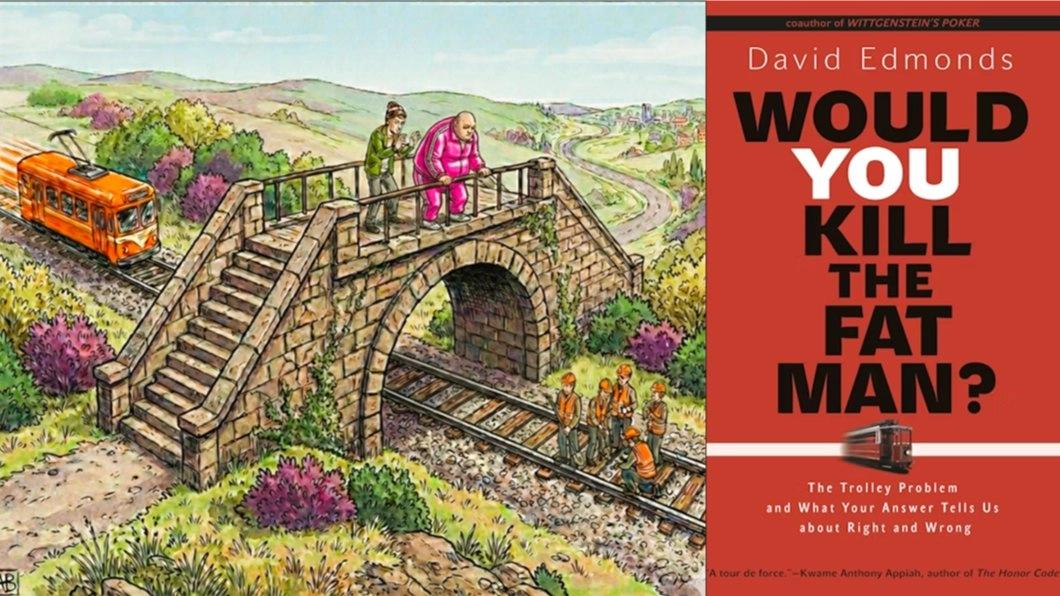
The Trolley Problem: Would you kill the fat man?
Chances are you've heard some version of this before, but it's worth revisiting. A runaway trolley is hurtling down the tracks toward five unsuspecting workers. You're standing on a footbridge above, and beside you is a large man. If you push him onto the tracks, his body will stop the trolley. He will die—but the five will live. Would you do it? What if pushing him saved a hundred people? This is no idle riddle. Our responses to this famous thought experiment (and many variants of it) reveal how we weigh consequences, rights, and intentions, and how our moral intuitions can clash with our moral reasoning. Moreover, these choices matter in the real world. From foreseeable risks to civilian lives in military action, to public‑health decisions about allocating scarce vaccines, to autonomous vehicles deciding who to save in a crash, trolley problems offer an accessible way to confront the hard edges of moral decision‑making in the modern age. Let's dive in.
Primary Reading: An Introduction to the Trolley Problem (document prepared for this discussion)
(Optional) Book: Would You Kill the Fat Man? The Trolley Problem and What Your Answer Tells Us About Right and Wrong (2014) by David Edmonds
For this meetup, we’ve prepared a 40-page guide that introduces the Trolley Problem, its philosophical significance, and what neuroscience has learned from using it to study moral decision-making. The guide includes sixteen scenarios, each probing different aspects of moral thinking: How do we weigh consequences against rights? Does intention matter more than outcomes? Do personal relationships override impartial calculation? When is it acceptable to use one person to save many? These scenarios reveal the complexity of our moral intuitions and will form the heart of our discussion.
Hopefully the prepared guide will leave you wanting more. If so, David Edmonds' *Would You K




26 Foveaux St, 2010, Surry Hills
Itinéraire